The Continuity Error That Is Not a Secret Clue
Learn how to read a continuity error without mistaking a shifting prop or image detail for a secret clue, using a measured scene-by-scene viewing routine.
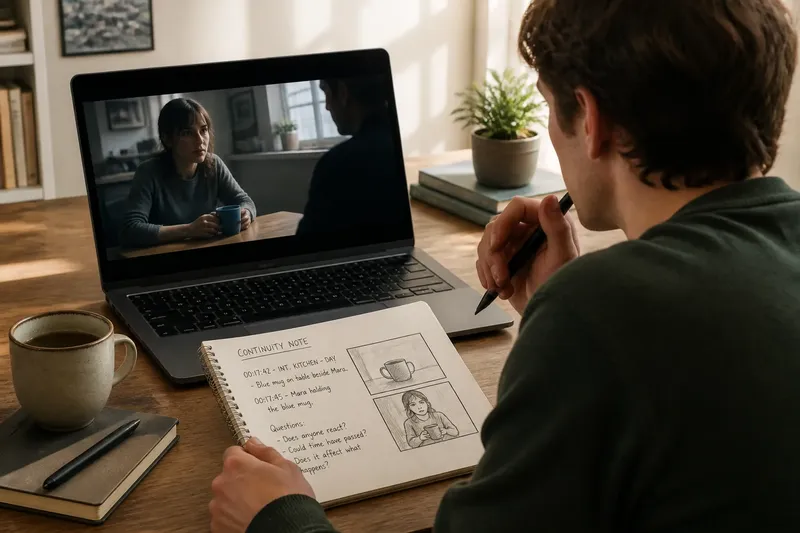
Does that glass changing hands mean something, or did the film simply lose track of it? A continuity error can look deliberate because it appears on screen, where every visible detail feels chosen. Before treating a mismatched prop as a secret clue, give the scene a fair reading: note what changes, check whether the story uses that change, and allow for an ordinary production inconsistency.
This week-long routine helps separate observable story evidence from a visual mismatch without turning a film into a forensic puzzle. It takes only a few brief notes, and you can stop as soon as the detail has a sensible explanation—or no bearing on the story.
Start by describing the mismatch plainly
On the first watch, record only what the camera shows. Write “the blue mug is beside Mara, then in her hand” rather than “Mara has forgotten something” or “the mug signals a change in identity”. The first sentence is observable; the others are interpretations.
Keep the note tied to a precise moment: the scene, the people present and the detail that changes. Useful details include a jacket fastening, a mark on a face, an object’s position, a door’s state or the amount of liquid in a glass. Avoid recording every tiny variation. Choose the mismatch that actually distracts you or seems relevant to what happens next.
For this first pass, do not pause the film, rewind repeatedly or search for explanations online. A stopped frame can make a minor difference seem more significant than it felt in motion. Your aim is to preserve what you noticed, not to prove that the film contains a clue.
Keep the first watch focused on the story
Later in the week, watch the film through without actively hunting for the detail. Follow the characters’ choices, the scene’s emotional turn and the information the film makes clear. If the object changes again, notice whether the story draws attention to it through an action, a reaction, dialogue or a consequence.
A mismatch may become relevant if a character notices it, if another shot gives it unusual emphasis, or if later events depend on its location or condition. It may remain a mismatch if nobody responds and the scene continues unchanged. Neither pattern settles every question, but it gives you more to work with than the visual difference alone.
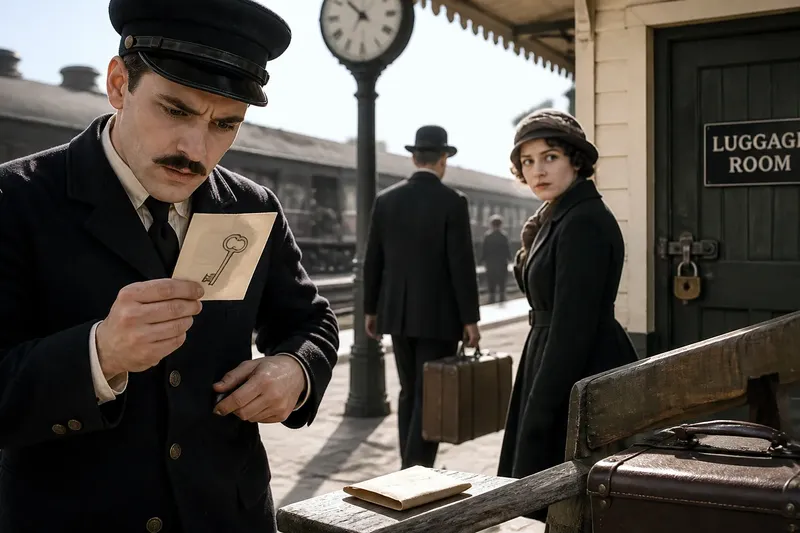
Say you notice a key lying on the table in one shot and tucked into a character’s coat in the next, with no visible movement between. Imagine that the character later uses the key to open a door and another character asks where it came from. That later attention gives the key a story role worth examining. If the conversation and action proceed as though its position never mattered, the unexplained jump is more likely an inconsistency than hidden evidence.
Compare the shots only after the scene makes sense
On a later day, return to the scene and watch it once at normal speed. Then, if the question remains, replay the adjacent shots. You are checking whether the apparent change could have happened during an omitted action, a change of camera angle or a cut to a different moment—not searching for an answer the film never supplies.
Ask a few specific questions:
- Does the object move while the camera is showing something else?
- Could the shots belong to different moments, even if the edit does not make that clear?
- Does the object’s changed position affect what a character can do?
- Does anyone look at, mention or handle the detail in a way the scene treats as significant?
- Does the film return to the same detail later?
A cut can compress time, so a prop need not stay in precisely the same place across every angle. But an unaccounted change is not automatically an intentional ellipsis. Look at the scene’s wider rhythm: a clear shift in time or activity offers one explanation; a quick conversational exchange with no apparent break makes a continuity slip more plausible.
Do not spend ages comparing frame grabs or adjusting playback settings to make a tiny difference decisive. That effort is rarely useful when the film itself never directs attention to the detail. A single careful replay is usually enough to tell whether the change has an obvious explanation.
Test what the detail contributes to the story
Once you have checked the cut, ask what would be different if the detail were removed. Would a character’s decision become confusing? Would a later action lose its cause? Would the audience miss information that the film otherwise treats as necessary? If the answer is no, the mismatch may be visible without being meaningful.
Story evidence usually has some connection to the film’s own pattern of attention. A detail may matter because a character reacts to it, because it recurs, or because it changes what happens. A continuity error can still be used deliberately, but its mere presence does not establish that intention. Look for a relationship between the detail and the unfolding scene, not just an interesting coincidence.
There is also a middle ground: a detail can be an actual continuity inconsistency and still invite a viewer’s interpretation. You can notice a possible association without claiming the filmmakers planted it. Keep those statements separate: “the ring changes hands between shots” describes the image; “the film may be linking the ring to the argument” is a reading that needs support from the scene.
Use the week to settle what you can
Spread the routine over several days rather than revisiting the same seconds until you feel certain. A practical plan is to make the plain note on the first watch, follow the story on the next, compare the cut later, then leave the film alone for a day before deciding whether the detail matters. If another viewing adds no new evidence, stop there.
Separate your final note into three parts: what changed on screen, what the story did with that change, and what remains uncertain. This small distinction prevents an observation from quietly becoming a claim about intention. It also gives you permission to leave a question open when the film does not answer it.
For example, imagine you wrote that a character’s sleeve is rolled up in one shot and down in the next. On the story-focused watch, nobody reacts, and the scene’s action does not depend on the sleeve. After checking the cut, you find no clear moment when it changes. A measured conclusion is that the sleeve appears inconsistent and has no evident story function—not that it secretly reveals a character’s hidden plan.
When does a continuity error count as a clue?
Can a continuity error be intentional?
It can be, but the mismatch alone cannot tell you that. Look for the film to connect it to a character’s awareness, a repeated image or a later event.
Does a recurring prop change prove a hidden meaning?
No. Recurrence makes the detail easier to notice, but its story role depends on how the film uses it. Check whether characters or events respond to the change.
Should you look up the answer after watching?
Only if you want outside discussion, and keep other viewers’ interpretations separate from what the film itself shows. A confident online explanation is still an interpretation unless the film supports it.
What if the film never explains the mismatch?
Leave it unresolved. You can describe the visible inconsistency accurately without deciding whether it was accidental or intended.
Keep the conclusion proportionate to the evidence
When you finish the week, write one short sentence about the detail. “The glass changes position between shots, and nothing later depends on it” is firmer and more useful than “the glass must be a secret symbol”. If the story does return to it, name the specific action or response that gives it weight.
This routine does not strip films of ambiguity; it keeps ambiguity from doing too much work. Treat a continuity error as an observation first, then ask whether the film builds a meaningful connection around it. When the answer is unclear, the most accurate reading may simply be that the image changes and the story leaves it alone.
For a continuity error, measured attention is more useful than certainty: record the mismatch, check its place in the scene and let the film’s own emphasis determine how much meaning it can reasonably bear.